


Highlights in 2024/25
Some of the work highlighted in our Annual report.
The full report is available at the bottom of this page,
- Strengthening the health system
- Engaging with consumers and whānau
- Enabling the health workforce
- Leading health quality intelligence
- Preventing avoidable mortality
Strengthening the health system
We help shape the national focus on health quality and safety, leading to measurable improvements in areas where data has highlighted the greatest need.
Paediatric early warning system
 Our quality improvement projects and programmes for the health system included the national roll-out of the paediatric early warning system which has improved compliance with documenting vital signs and supported consistent recognition and recording of concerns raised by family and their whānau.
Paediatric early warning system
Progress on improving trauma outcomes
We continued our work to improve outcomes for people with serious traumatic injuries. working in partnership with Health New Zealand I Te Whatu Ora and ACC. In December 2024, we published the Serious Traumatic Brain Injury Collaborative progress report. The report highlights the work of nine hospital teams from across the country who participated in a national serious traumatic brain injury quality improvement initiative.
Read the Serious traumatic brain injury progress report
Clinical governance framework

We influenced changes in the health system by developing a clinical governance quality framework that is used across the health sector to strengthen accountability and improve patient care and experience. The framework enables health organisations to develop their own clinical governance models to support high-quality care for everyone.
Engaging with consumers and whānau
Consumers and whānau perspectives are a core element in designing health systems and services to become more responsive and effective.
Implementing the Code of expectations
 We lead and support the implementation of the Code of expectations for health entities’ engagement with consumers and whānau (the Code).
We also support the primary and community health care sector to implement the Code of expectations. We developed Partnership in Care: Consumer, whānau and community engagement in primary and community health care to help these services strengthen their engagement with consumers, whānau and communities, in line with the Code.
Partnership in care: consumer, whānau and community engagement in primary and community health care
Patient experience surveys
 We gain valuable feedback from health consumers and whānau through our patient experience surveys. In 2024/25 we heard from more than 200,000 people on how they access and navigate the health system. These findings help highlight what’s working well and where challenges remain in hospitals and primary care services.
Enabling the health workforce
We supported the health workforce’s capability in quality and safety through our education programmes.
This year we educated more than 260 health care professionals across the sector by delivering workshops, online learning modules, master classes and one-to-one coaching.
Improving together
 The Improving together education programme continued in 2024/25 with 22 health care workers from across the health sector completing the Improving together: Advisors programme. It involves developing an understanding of the wider complexities of the health system, along with approaches for leading quality improvement, and expands on the quality improvement skills and knowledge to facilitate change in the health sector.
Learning from harm
 We also provided learning from harm education through online learning modules and workshops. This supports the health sector to follow the Healing, learning and improving from harm: National adverse events policy 2023 and contributes to continuing professional development, which may be applied towards registration requirements.
Leading health quality intelligence
We strengthen the system’s ability to respond quickly to emerging quality and safety risks by providing timely insights into the quality of health service delivery.
Home and community support services experience survey
 An annual survey designed to capture people’s experiences of their home and community support services experience was launched in September 2024. Health service providers can use the results to improve service quality and better meet people’s needs.
Explore the Home and community support services experience survey
New section for the Atlas of Healthcare Variation
In December 2024, we published a new chronic obstructive pulmonary disease (COPD) section on the Atlas of Healthcare Variation. The Atlas shows variation between the health care received by people in different geographical regions.
It aims to highlight regional and demographic variation in the prevalence of COPD, as well as in hospital admissions and medicine use among people with this condition. This new Atlas domain provides valuable insights to support conversations about health care differences and possible reasons for those differences.
Explore the Atlas of Healthcare Variation
Preventing avoidable mortality
Our mortality reviews identify opportunities and influence health system change with the goal of preventing avoidable mortality and morbidity.
Understanding the impact of gender-based violence
 Our National Mortality Review Committee He Mutunga Kore published Femicide: Deaths resulting from gender-based violence in Aotearoa New Zealand in June 2025. The report takes a broad approach to understanding femicide, the gender-based killing of women and girls. Our aim is to spark a national conversation about the impact of gender-based violence and the strategies needed to prevent and respond to it.
Read Femicide: Deaths resulting from gender-based violence in Aotearoa New Zealand
Safety and risks of surgery
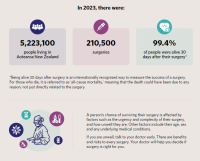 We provided updated data around the safety and risks of having surgery in New Zealand. We released information that highlights survival rates and the overall safety of surgeries. It shows overall surgical mortality rates in New Zealand are not increasing even though the population is ageing and more complex surgeries are being performed.
Attachments

