


Hospital sepsis pathways
National pathways and guidance to support the early recognition, assessment and treatment of sepsis in hospital settings.
Any health care provider can initiate a sepsis pathway.
National sepsis pathways for treating adult, paediatric and maternity patients
- screen patients for sepsis and identify level of risk
- treat patients identified as being at high risk of sepsis.
The sepsis pathways are endorsed by Health New Zealand | Te Whatu Ora.
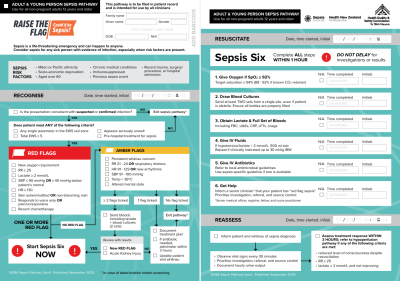
Adult pathway
Use this pathway for patients who are not pregnant and are 12 years or older.
Adult sepsis pathway (PDF 266KB)
Paediatric pathway
Use this pathway for children aged from 29 days to under 12 years. Vital sign parameters are aligned with age-appropriate ranges.
Paediatric sepsis pathway (PDF 268KB)
Maternity pathway
Use this pathway for pregnant and postpartum patients up to 6 weeks post-delivery. The pathway gives special consideration to physiological changes in pregnancy.
Maternal sepsis pathway (PDF 267KB)
Hypoperfusion pathway
Use for anyone 12 years or older along with the adult or maternal sepsis pathway.
Professional print versions of pathways
These files must be printed by a professional printing service. They are not suitable for self-printing.
Supporting guidance
National Sepsis Pathway User Guide
The national sepsis pathway user guide explains how to complete and use the national sepsis pathway across a range of clinical settings.
Raise the Flag: National Sepsis Pathway User Guide (PDF 1.5MB)
Raise the Flag National Sepsis Pathway User Guide (DOCX 3.8MB)
Clinical Guide to Sepsis Management in New Zealand
This clinical guide covers the recognition, diagnosis and early management of sepsis. It is for health care professionals working in primary, secondary and tertiary care. People who have experienced sepsis and their family/whānau can use it as a care standard. This guide:
- is to help professionals and patients make decisions about the most appropriate treatment and care for specific clinical circumstances
- can be used to develop standards to assess the clinical practice of individual health professionals and organisations
- can support the education and training of health professionals and others
- can improve communication between patients and health professionals.
Clinical guide to sepsis management (PDF 713KB)
Clinical guide to sepsis management (DOCX 2.5MB)
Blood culture diagnostic stewardship for adults: take care and take two
Blood cultures are essential for the diagnosis and management of sepsis and severe infections. This document explains diagnostic stewardship principles for taking blood cultures.
The current recommendation is to take at least two blood culture sets from one site where possible. Further information is available in the guidance below.
Blood culture diagnostic stewardship for adults: take care and take two (nznm.org.nz)
