


Frailty care guides: Chronic obstructive pulmonary disease (COPD) He mate puru ia auraki
Return to the list of Frailty care guides
Contents
- Definition
- Why this is important
- Implications for kaumātua
- Assessment
- Treatment
- Care planning long-term COPD
- Care planning exacerbation of COPD
- Associated care guides
- Decision support
- References | Ngā tohutoro
The information in this guide is accurate to the best of our knowledge as of June 2026. This guide is based on New Zealand COPD Guidelines: 2025 update (Hancox et al 2025). For full details refer to that guideline.
Definition
Chronic obstructive pulmonary disease (COPD) is a generic term covering three conditions: chronic bronchitis, emphysema and chronic airflow obstruction. All three result in limited flow of air through the lung that worsens over time. Unlike asthma, this limitation is not reversible with treatments. Primary symptoms are cough, sputum production, shortness of breath and wheezing (Hancox et al 2025). However, COPD affects every aspect of a person's life.
Key points
- Exacerbations are common and have a significant mortality risk.
- Many people with COPD also have comorbidities that have a substantial impact on their wellbeing and may be the underlying cause of an apparent exacerbation (Hancox et al 2025).
- COPD is a risk factor for heart failure (HF), and the two diagnoses often co-exist in older people: an estimated 20 percent of people with COPD have HF, while 25-50% of those with HF also have COPD (Corneanu et al 2025)
Why this is important
Severe COPD impacts on every aspect of the person’s life and contributes significantly to the state of frailty.
Implications for kaumātua*
Breath and breathing are significant in Māori culture. Te reo Māori has several words for breath, many of which link breath and breathing to te taiao (the natural world) and to Māori creation stories. While these cultural constructs do not change the occurrence, cause or treatments of breathlessness or COPD, it is important to understand them because experiencing breathlessness may contribute to anxiety or wairua (spiritual) unrest.
For more information see our Guide for health professionals caring for kaumātua | Kupu arataki mō te manaaki kaumātua
*Kaumātua are individuals, and their connection with culture varies. This guide provides a starting point for a conversation about some key cultural concepts with kaumātua and their whānau/family. It is not an exhaustive list; nor does it apply to every person who identifies as Māori. It remains important to avoid assuming all concepts apply to everyone and to allow care to be person and whānau/family led.
Assessment
COPD is diagnosed and the severity of disease is assessed by a combination of symptoms experienced every day, as well as lung function testing.
| State | Symptoms |
FEV1 |
|---|---|---|
| Mild |
Few symptoms Breathless with moderate exertion Little effect on daily activity Cough and sputum production |
60–80% of predicted |
| Moderate |
Breathless walking on flat Increased limitation on daily activity Recurrent chest infections Exacerbations requiring oral corticosteroid and/or antibiotics |
40–59% of predicted |
| Severe |
Breathless on minimal exertion Daily activities severely impacted Exacerbations increasing in frequency and severity |
`<40% of predicted |
Note: Forced expiratory volume (FEV1), measured by spirometry, is the amount of air that can be forced out of the lungs over 1 second.
Treatment
Non-pharmacological
- Provide support for smoking cessation.
- Provide physical activity support (pulmonary rehabilitation where available).
- Offer breathlessness management strategies (pursed lip breathing, handheld fan, energy conservation - Note that oxygen is not an effective strategy for breathlessness in people who are not hypoxic or who are on long-term oxygen therapy).
- Provide culturally informed, complementary therapies that promote breath control, such as Hikitia te Hā (te ao Māori breathing exercises) or waiata (singing). Whānau/family or a cultural advisor may recommend other therapies.
- Support sputum clearance.
- Provide nutritional support.
- Support the resident and their whānau or family to understand the disease process.
- Develop an individual management or action plan (including documentation of the patient's normal oxygen saturation (SpO2) and whether the resident is a know carbon dioxide (CO2) retainer).
- Discuss goals of care.
- Support sleep with positioning, temperature and ventilation and consider timing of bronchodilators (Braghiroli et al 2020).
Pharmacological
Long-term management with inhaled medication
Many different inhaled medications for COPD are used in combination to manage symptoms and prevent exacerbations, with specific inhalers, depending on the severity of disease and primary presenting issues. Important nursing roles in managing COPD regimes include the following.
- Inhaler reconciliation – given patients often have multiple inhalers (from different treatment stages), this involves checking that the regimen the patient is following matches the regimen prescribed.
- Supporting inhaler use, management, technique (including spacer) and infection control.
- Monitoring and reporting COPD symptoms (as this is a progressive disease, treatments may need to change).
Although treatment may vary between individuals, generally treatment escalates through steps to get maximum control of COPD symptoms.
1. Provide short-acting relief of breathlessness.
a. Choices are short-acting beta2 agonist (SABA) or short-acting muscarinic agonist (SAMA) or a combination (SAMA salbutamol or terbutaline, SAMA ipratropium).
2. Introduce long-acting muscarinic antagonist (LAMA).
a. Examples are tiotropium, glycopyrronium and umeclidinium.
b. SABA can continue.
c. Ipratropium stops – except in emergency situations.
3. Replace LAMA with a combination of LAMA with long-acting beta2 agonist (LABA).
a. Examples are glycopyrronium/indacaterol, umeclidinium/vilanterol and olodaterol/tiotropium.
4. Use inhaled corticosteroids for people with severe disease.
a. Examples include fluticasone and budesonide.
Identifying inhalers
The Cardiac and Respiratory Foundation New Zealand provides an 'Inhaler device identification' chart on it's website: cardiacandrespiratory.org.nz/resource-hub/inhaler-devices-identification-chart/
Immunisations
Immunisations are recommended to reduce the risk of viral or bacterial exacerbation of COPD, with recommended vaccinations the following:
- Annual influenza (funded)
- Pneumococcal vaccination (unfunded)
- COVID-19 (funded
- Respiratory syncytial virus (RSV) (unfunded)
Long-term oxygen therapy
Accessed through a specialist respiratory service, oxygen is prescribed for hypoxia (not breathlessness) to improve survival and quality of life by reducing right heart strain. Delivered via nasal cannula, it is used for 15 hours a day (Hancox et al 2025).
Care planning long-term COPD
Continuing care for COPD
Severe COPD impacts all aspects of a person’s health and wellness on a daily basis. Help an older person save their breath for doing the things that are most important to them. Care planning includes, but is not limited to, nutrition and hydration, bowel management, skin and bone health, strength and balance, anxiety (particularly panic attacks) and social isolation.
For kaumātua, consider culturally informed holistic interventions including physical activities such as kapa haka, waiata, and/or te ao Māori breathing exercises (Hikitia te Hā: www.allright.org.nz/tools/hikitia-te-ha).
Whānau or a cultural advisor may recommend other interventions.
Care planning (exacerbation of COPD)
Identify an exacerbation
An exacerbation of COPD is a temporary (often reversible) worsening of COPD symptoms, different to usual variation. It can occur in people with mild, moderate or severe disease. Exacerbations can develop over hours or days and are most often caused by a viral or bacterial respiratory tract infection. Having an individual plan developed that includes a record of the resident's usual oxygen saturation, nurse-initiated treatment and goals of care can be helpful.
Symptoms of an acute exacerbation of COPD include:
- increased difficulty breathing
- increased sputum purulence and production
- increased cough and wheeze
- for some, a reduction in oxygen saturation.
Be aware that:
- acute exacerbations can be difficult to distinguish from heart failure, pulmonary embolus, acute coronary syndromes and pneumonia, so evaluation by a general practitioner (GP) or nurse practitioner (NP) is required
- acute deterioration events may be unrelated to COPD
- refer to our guides
Guide to exacerbation severity
It is important to recognise individual variation; not all residents will exhibit all these symptoms.
| Mild to moderate | Severe | Life threatening |
|---|---|---|
| More short of breath than usual | Very short of braeth | Extremely short of breath |
| Able to speak in sentences | Speaks only a few words | Unable to speak |
| Usually has a wheeze | - | May not have a wheeze |
| Some chest/neck indrawing | Severe chest/neck indrawing | May be no chest/neck indrawing |
| - | Tripod positioning | - |
| SpO2 near usual level | SpO2 well below usual | SpO2 falling rapidly |
| Normal level of conciousness | May be agitated | Severe agitation of falling level of consciousness |
This guide has been reproduced from the New Zealand COPD Guidelines: 2025 update (the guidelines) (Hancox et al 2025).
Exacerbation treatment guide
Treatments are aimed at addressing symptoms. they include optimum positioning, bronchodilators, corticosteroids and antibiotics, and sometimes oxygen therapy.
Positioning
Allow the person to position themselves according to their preference. Maximise physical support with pillows, a chair back or over-bed table to help save their energy for breathing (Barnett et al 2022).
Bronchodilators
The guideline recommend the use of short-acting bronchodilator (salbutamol) metered dose inhaler (Hancox et al 2025). the inhaler should be delivered via a spacer, one actuation at a time (one puff with 4–5 tidal breaths). Some people are established users of an air-driven nebuliser, which may be the required delivery method. Nasal prongs can remain in place during bronchodilator therapy (Barnett et al 2022).
Notes
- In life threatening exacerbations, the guidelines recommend nebulised salbutamol 2.5mg and ipratropium 500mcg via air nebuliser.
- Oxygen-driver nebulisation is not recommended.
Corticosteroids
Systematic corrticosteroids can improve lung function, oxygenation and recovery. The guidelines recommend 40mg prednisone daily for five days (Hancox et al 2025).
Antibiotics
Antibiotics can shorten recovery time and reduce risk of relapse if there is evidence of infection. Consider sputum culture if the person has recurrent exacerbation or does not respond to antibiotics.
Oxygen in exacerbation of COPD
If indicated (the person has lower than usual oxygenation saturation), administer oxygen via nasal prongs or controlled oxygen flow device (for example, venturi mask).
Titrate oxygen to reach target oxygen saturation of 88–92%.
The role of opioids, benzodiazepines and antidepressants therapy in COPD
Treatment of COPD breathlessness with opioids, benzodiazepines and antidepressants is no longer recommended except in palliative and end-of-life care (Hancox et al 2025). People living in care with severe COPD may meet this definition or require the following medications for comorbities.
- Use of opioids requires shared decision making, considering adverse effects as well as potential benefits. Toward end-of-life benefit may outweigh risk of harm.
- Benzodiazepine and antidepressants do not reduce breathlessness in severe COPD. They may be required for treating depression and anxiety.
Associated care guides
- Acute deterioration.
- Syncope and collapse.
- Approach to breathlessness.
- Shared goals of care.
Decision support
Routine review of COPD care
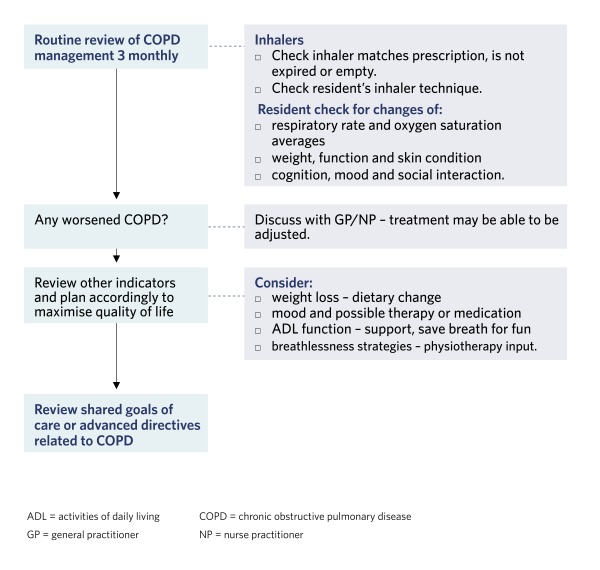
Text alternative for Routine review of COPD care flowchart
This flowchart shows the steps for a routine COPD review every three months.
Step 1: Review COPD management every three months.
- Check that the inhaler matches the prescription and is not empty or expired.
- Check inhaler technique.
- Look for changes in:
- breathing rate and oxygen levels
- weight, function, and skin condition
- thinking, mood, and social interaction
Step 2: Has COPD worsened?
If COPD has worsened, discuss with a GP or nurse practitioner. Treatment may need to be adjusted.
Step 3: Review other factors affecting quality of life and plan care.
Consider:
- weight loss and dietary changes
- mood and possible therapy or medication
- support with activities of daily living (ADLs)
- breathlessness management strategies, including physiotherapy
- Review shared goals of care and any COPD-related advance care directives.
Abbreviations:
COPD: Chronic obstructive pulmonary disease
ADL: Activities of daily living
GP: General practitioner
NP: Nurse practitioner
Exacerbation of COPD
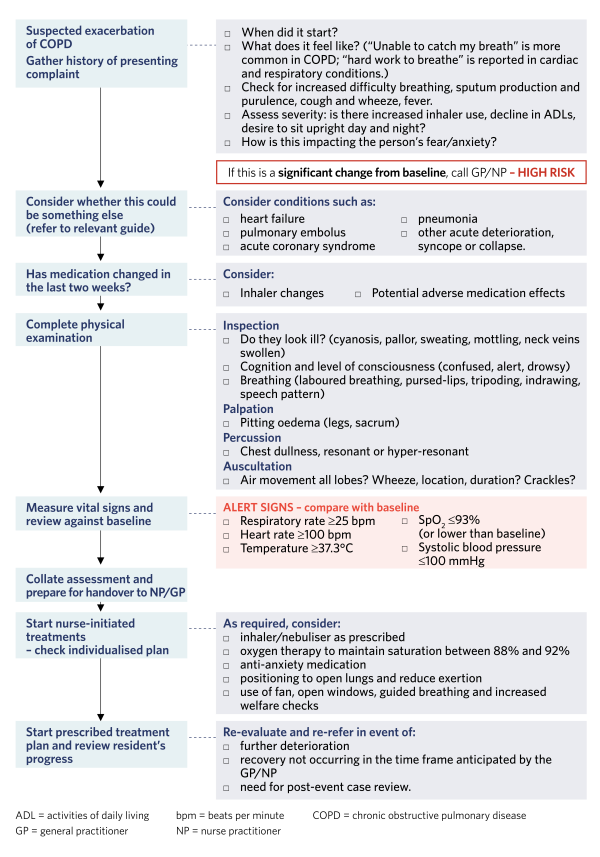
Text alternative for exacerbation of COPD flowchart
This flowchart outlines the assessment and management of a suspected exacerbation (flare-up) of chronic obstructive pulmonary disease (COPD).
Step 1: Gather information about the presenting complaint. Ask:
- When symptoms started.
- What the breathing problem feels like.
- Whether there is increased breathlessness, sputum production or changes in sputum, cough, wheeze, or fever.
Whether inhaler use has increased. - Whether there has been a decline in activities of daily living (ADLs).
- Whether the person needs to sit upright day or night to breathe more comfortably.
- How symptoms are affecting anxiety or fear.
High risk: If there is a significant change from the person's usual baseline, contact a GP or nurse practitioner immediately.
Step 2: Consider other possible causes of the symptoms. Conditions to consider include:
- Heart failure
- Pulmonary embolism
- Acute coronary syndrome
- Pneumonia
- Other acute deterioration, fainting, or collapse
Step 3: Check whether medication has changed in the last two weeks. Consider:
- Changes to inhalers
- Possible medication side effects
Step 4: Complete a physical examination. Assess:
- General appearance for signs of serious illness, including:
- cyanosis (bluish discolouration)
- pallor
- sweating
- mottling of the skin
- swollen neck veins
- Cognition and level of consciousness, such as confusion, alertness, or drowsiness.
- Breathing effort and breathing pattern, including:
- laboured breathing
- pursed-lip breathing
- tripod positioning
- chest indrawing
- changes in speech pattern
Signs of pitting oedema in the legs or sacrum.
- Chest percussion findings, including dull, resonant, or hyper-resonant sounds.
- Lung sounds and air movement, including:
- reduced air movement
- wheeze
- crackles
- location and duration of abnormal sounds
Step 5: Measure vital signs and compare them with the person's usual baseline. Alert signs include:
- Respiratory rate of 25 breaths per minute or higher
- Heart rate of 100 beats per minute or higher
- Temperature of 37.3°C or higher
- Oxygen saturation (SpO₂) of 93% or lower, or lower than the person's usual level
- Systolic blood pressure of 100 mmHg or lower
Step 6: Collate assessment findings and prepare handover to the nurse practitioner or GP.
Step 7: Start nurse-initiated treatments according to the individualised care plan. This may include:
- Prescribed inhaler or nebuliser treatment
- Oxygen therapy to maintain oxygen saturation between 88% and 92%
- Anti-anxiety medication
- Positioning to make breathing easier
- Using a fan, opening windows, guided breathing, and increasing welfare check
Step 8: Start the prescribed treatment plan and monitor progress. Reassess and seek further review if:
- The person's condition deteriorates further
- Recovery is not occurring within the timeframe expected by the GP or nurse practitioner
- A post-event case review is needed
Abbreviations:
COPD: Chronic obstructive pulmonary disease
ADL: Activities of daily living
GP: General practitioner
NP: Nurse practitioner
bpm: Beats per minute
SpO₂: Oxygen saturation level measured by pulse oximetry
References | Ngā tohutoro
Asthma and Respiratory Foundation New Zealand. 2025. Inhaler device identification. URL:
asthmafoundation.org.nz/assets/documents/ARFNZ-He-Ako-Hiringa-Inhaler-ID-A3-poster-2025.pdf
(accessed 13 July 2026).
Barnett A, Beasley R, Buchan C, et al. 2022. Thoracic Society of Australia and New Zealand position
statement on acute oxygen use in adults: ‘Swimming between the flags’. Respirology 27(4): 262–76.
DOI: https://doi.org/10.1111/resp.14218 (accessed 13 July 2026).
Braghiroli A, Braido F, Pirainia A, et al. 2020. Day and night control of COPD and role of
pharmacotherapy: a review. International Journal of Pulmonary Disease, 15 1269–85. DOI: https://doi.
org/10.2147/COPD.S240033 (accessed 13 July 2026).
Corneanu LE, Singeap MS, Mutruc V, et al. 2025. The complex relationship between heart failure and
chronic obstructive pulmonary disease: a comprehensive review Journal of clinical medicine 14(13) 4774.
DOI: https://doi.org/10.3390/jcm14134774 (accessed 26 June 2026).
Hancox R, Jones S, Baggot C, et al. 2025. New Zealand COPD Guidelines: 2025 update. Asthma and
Respiratory Foundation. URL: asthmafoundation.org.nz/health-professionals/management-guidelines/
nz-copd-guidelines (accessed 19 February 2026).
Hikitia Te Hā | All Right? nd. URL: allright.org.nz/tools/hikitia-te-ha (accessed 22 November 2022).
